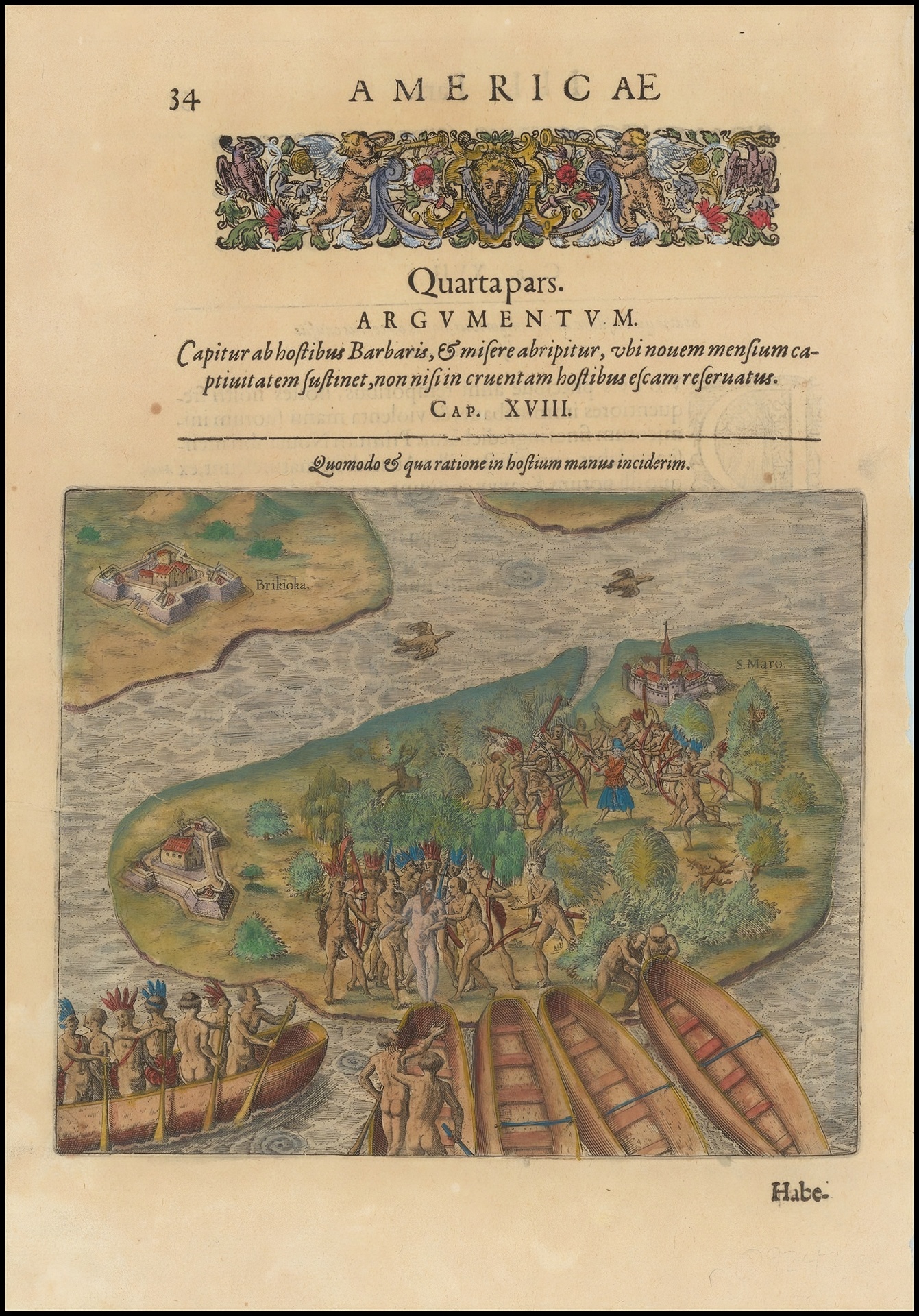
Ilha de Santo Amaro and Fort Bertioga (Brikioka). Theodor de Bry, Americae quarta pars
Engraved view from de Bry's Americae pars IV, after Hans Staden, showing Santo Amaro (captioned S. Maro), São Vicente, Bertioga (Brikioka), and Itanhaém.
- Date
- 1592
- Origin
- Amsterdam
- Period
- Colonial Period (1500–1822)
- Materials
- Paper and ink; hand-colored
- Dimensions
- 6.5 x 8 inches
- Condition
- VG
Provenance
US rare maps dealer
Historical Context
This engraved view comes from Americae pars IV, the Brazil volume of Theodor de Bry's Grand Voyages, issued at Frankfurt am Main with Johann Wechel in a Latin edition in 1592 and a German edition in 1593. The plate illustrates the account of Hans Staden and shows the coast of the São Vicente and Santos region: the island captioned S. Maro is Santo Amaro, now Guarujá, and the fort captioned Brikioka is Bertioga, with São Vicente and Itanhaém also depicted. The geography is reversed relative to the actual shoreline, and the settlements are drawn as walled European citadels. It is a workshop image produced in Frankfurt, not a survey made on the spot.
The underlying narrative is Staden's Wahrhaftige Historia (Marburg, 1557), the account of his two voyages to Brazil between 1547 and 1555 and of the months he spent as a captive of the Tupinambá on this stretch of coast. De Bry's edition carried Staden's story to a far wider European audience, pairing the text with engraved plates produced in the de Bry workshop.
Plates of this kind shaped Europe's earliest visual imagination of Brazil. Because the Grand Voyages circulated in both Latin and German and were reprinted for decades, images such as this view of Santo Amaro and Bertioga became the form in which many Europeans first encountered the Brazilian coast.
Maker
Theodor de Bry (1528–1598) Theodor de Bry (1528–1598) was a Flemish engraver and publisher best known for his illustrated collections of voyages to the New World. Born in Liège, de Bry hailed from the portion of Flanders then controlled by Spain. The de Brys were a family of jewelers and engravers, and young Theodor was trained in those artisanal trades.
As a Protestant living in territories under Spanish rule, de Bry faced increasing pressure during the religious conflicts of the late sixteenth century. In 1570 he was sentenced to banishment and his property was confiscated, forcing him to leave his native region. He fled to the Protestant city of Strasbourg, where he worked with the Huguenot engraver Étienne Delaune. De Bry later traveled to Antwerp and London before settling with his family in Frankfurt, where he established the publishing house that would produce the illustrated collections of voyages to the New World.
In 1590, de Bry began to publish the series known as the Grand Voyages, continued after his death by his two sons. The volumes contained engraved images of the New World, the first many Europeans had seen of these lands, together with several important maps. He also published a companion collection on India Orientalis. The Grand Voyages appeared in Latin and German, extending de Bry's fame and his vision of the New World across Europe.
Why This Item Matters
- Among the earliest widely circulated European images of the São Vicente / Santos coast
- 'St. Maro' on the plate is Santo Amaro (now Guarujá)
- The geography is reversed and the settlements are drawn as European citadels; it is de Bry's workshop image, not a survey
- Tied to Staden's Wahrhaftige Historia (Marburg, 1557), issued here in de Bry's Grand Voyages
Cite This Page
"Ilha de Santo Amaro and Fort Bertioga (Brikioka). Theodor de Bry, Americae quarta pars," Brazilian Heritage Collection, accessed September 26, 2026, https://www.brazilianheritagecollection.com/collection/st-maro-island-brazil-fort-bertioga.
Disclaimer: The information presented here represents our best-faith scholarly understanding based on available evidence. The Brazilian Heritage Collection does not offer legal guarantees of authenticity. Serious inquiries regarding provenance documentation are welcome from qualified researchers and institutions.