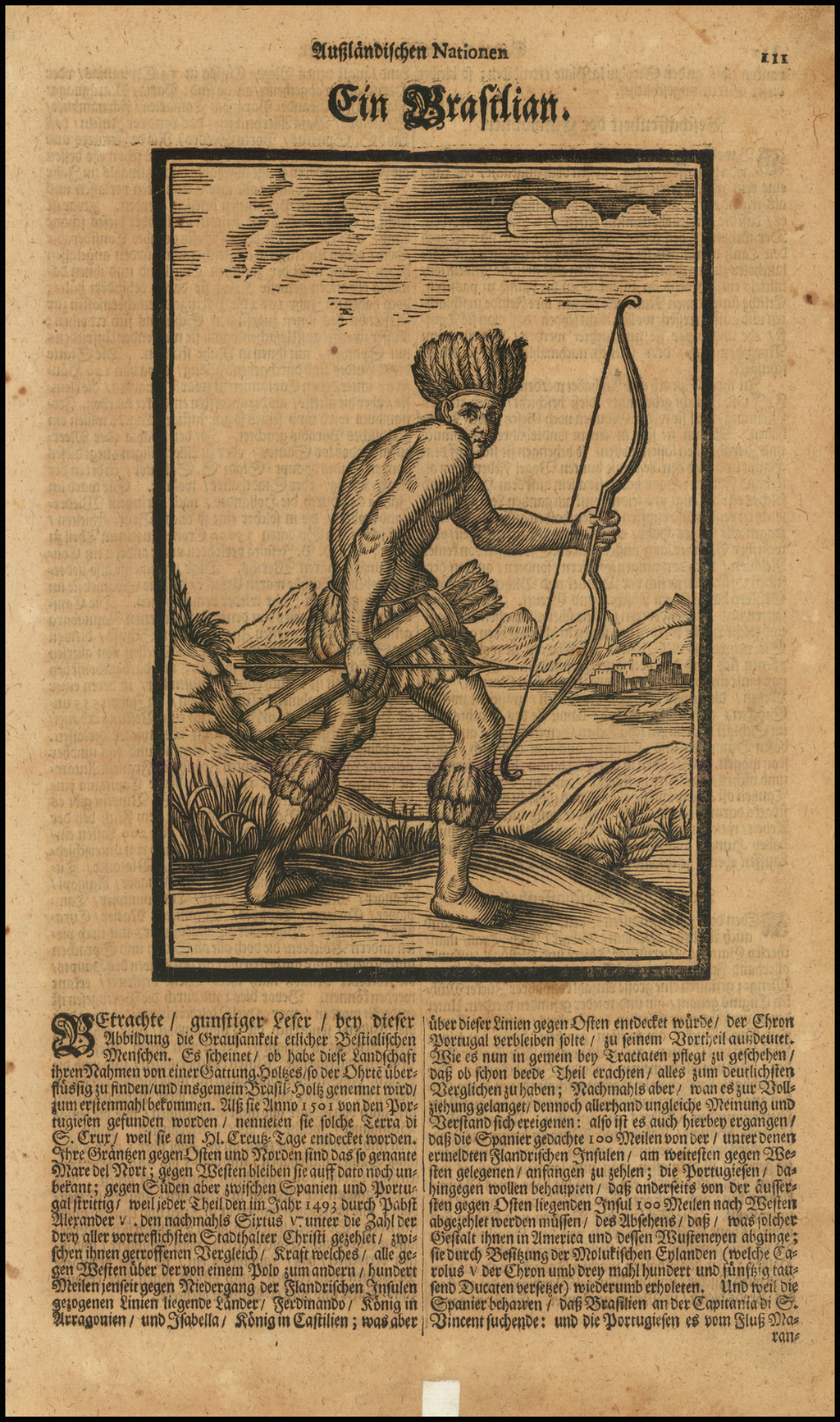
Ein Brasilian - HAPPEL, Eberhard Werner (1647 - 1690)
Hamburg, 1688 · Woodcut engraving by Eberhard Werner Happel · Early European depiction of an indigenous Brazilian figure in the Age of Exploration
- Date
- 1688
- Origin
- Hamburg
- Period
- Colonial Period (1500–1822)
- Materials
- Paper, ink
- Dimensions
- 7 x 12.5 inches Including Text
- Condition
- VG
Provenance
American rare maps dealer.
Historical Context
Ein Brasilian is a woodcut print dated 1688, published in Hamburg by the German polymath Eberhard Werner Happel. The image portrays a Brazilian indigenous man wearing a feathered headdress and carrying a bow and arrow—elements associated with native societies of coastal and interior Brazil in the early modern period. The figure is depicted in a dynamic pose, glancing over his shoulder, suggesting alertness and movement.
Happel was a prolific writer and compiler of geographical and historical works during the late seventeenth century. His publications sought to inform European audiences about distant regions of the world at a time when transatlantic exploration and global trade were reshaping intellectual and commercial life. This woodcut reflects the broader European interest in the lands and peoples encountered across the Atlantic during the Age of Discovery.
The portrayal of the Brazilian figure corresponds to visual conventions common in European prints of the period. Indigenous subjects were often represented through distinctive attire and weaponry intended to identify them to readers as inhabitants of newly described territories. Such imagery formed part of the broader effort to catalogue and describe the peoples of the Americas within early modern European geographical literature.
The accompanying text situates Brazil within the historical framework of Iberian exploration. It references the Portuguese arrival on the Brazilian coast in 1500 and the subsequent diplomatic arrangements between Spain and Portugal concerning overseas territories. These arrangements were formalized in the Treaty of Tordesillas (1494), negotiated following papal intervention under Pope Alexander VI, which established a demarcation line dividing spheres of influence between the two crowns. The agreement shaped the geopolitical development of South America for centuries.
In sum, Ein Brasilian is representative of late seventeenth-century European geographical publishing. It combines visual representation and explanatory text to present Brazil and its inhabitants to a European readership within the political and exploratory context of the early modern Atlantic world.
Eberhard Werner Happel (1647–1690) was a German author of scientific and historical works. The son of a reformist Lutheran minister, he studied law, mathematics, and natural sciences in Marburg, Germany, from the 1660s to 1680s, though due to financial issues he never finished his formal education. He also tutored aristocratic families in Hessen and Hamburg during this time. Around 1680 he devoted himself to writing, publishing several works of historical fiction. He also published several historical and scientific almanacs, the most famous of which was Historia Moderna Europae, which covered recent European political history and included detailed maps and engravings. His most famous scientific work was Gröste Denkwürdigkeiten der Welt: Oder, So genannte "relationes curiosae", which contained one of the most important early discussions of oceanographic phenomena. In later years Happel continued to be a successful and widely read author. He died in Hamburg at age 42, survived by his wife, Margarita, and four children.
Why This Item Matters
- Rare 17th-century European depiction of an indigenous Brazilian figure
- Visual evidence of early modern geographic knowledge circulation
- Published by Eberhard Werner Happel, a key German compiler of global histories
- Illustrates European interpretations of Brazil in the post-Tordesillas Atlantic world
Cite This Page
"Ein Brasilian - HAPPEL, Eberhard Werner (1647 - 1690)," Brazilian Heritage Collection, accessed September 19, 2026, https://www.brazilianheritagecollection.com/collection/happel-ein-brasilian-1688.
Disclaimer: The information presented here represents our best-faith scholarly understanding based on available evidence. The Brazilian Heritage Collection does not offer legal guarantees of authenticity. Serious inquiries regarding provenance documentation are welcome from qualified researchers and institutions.