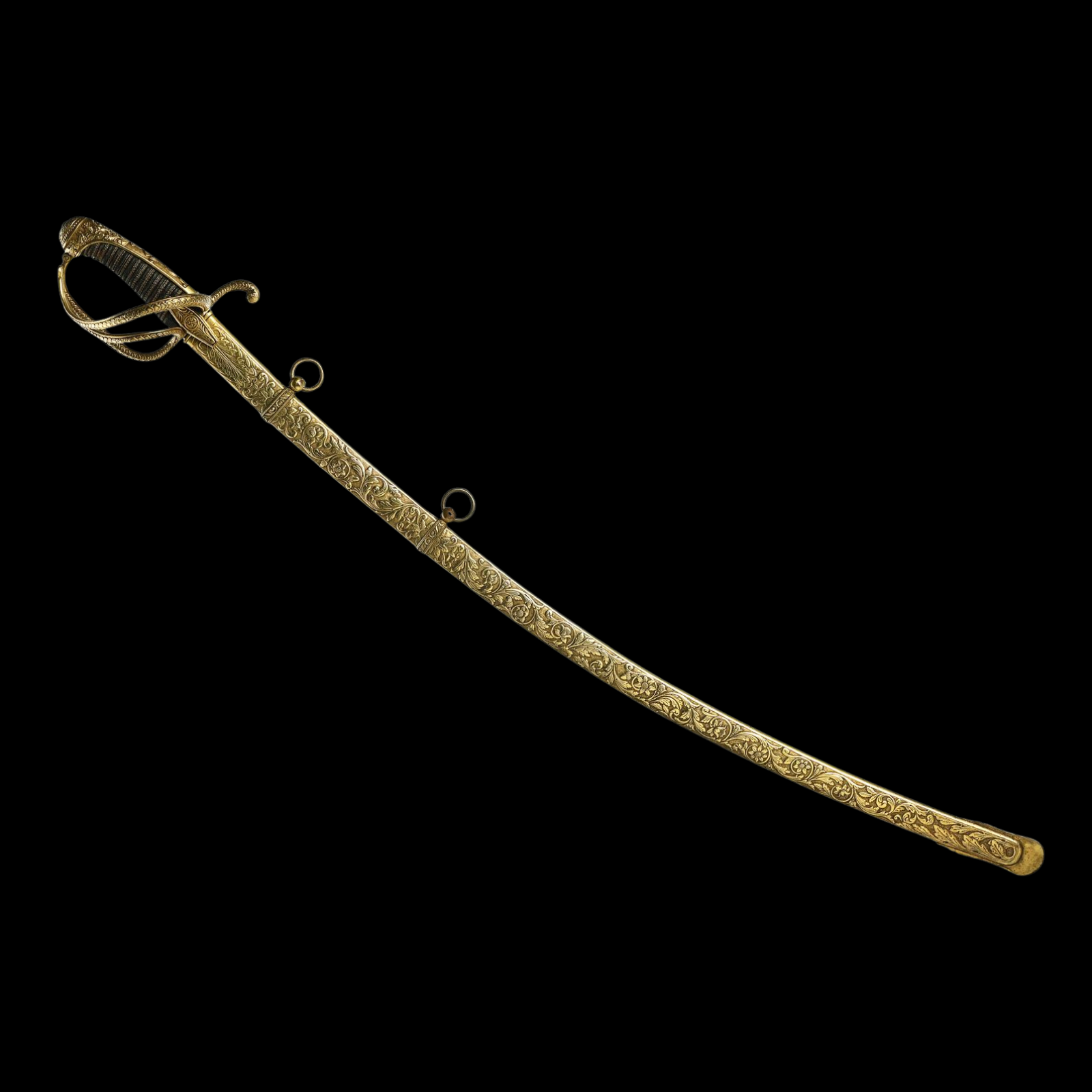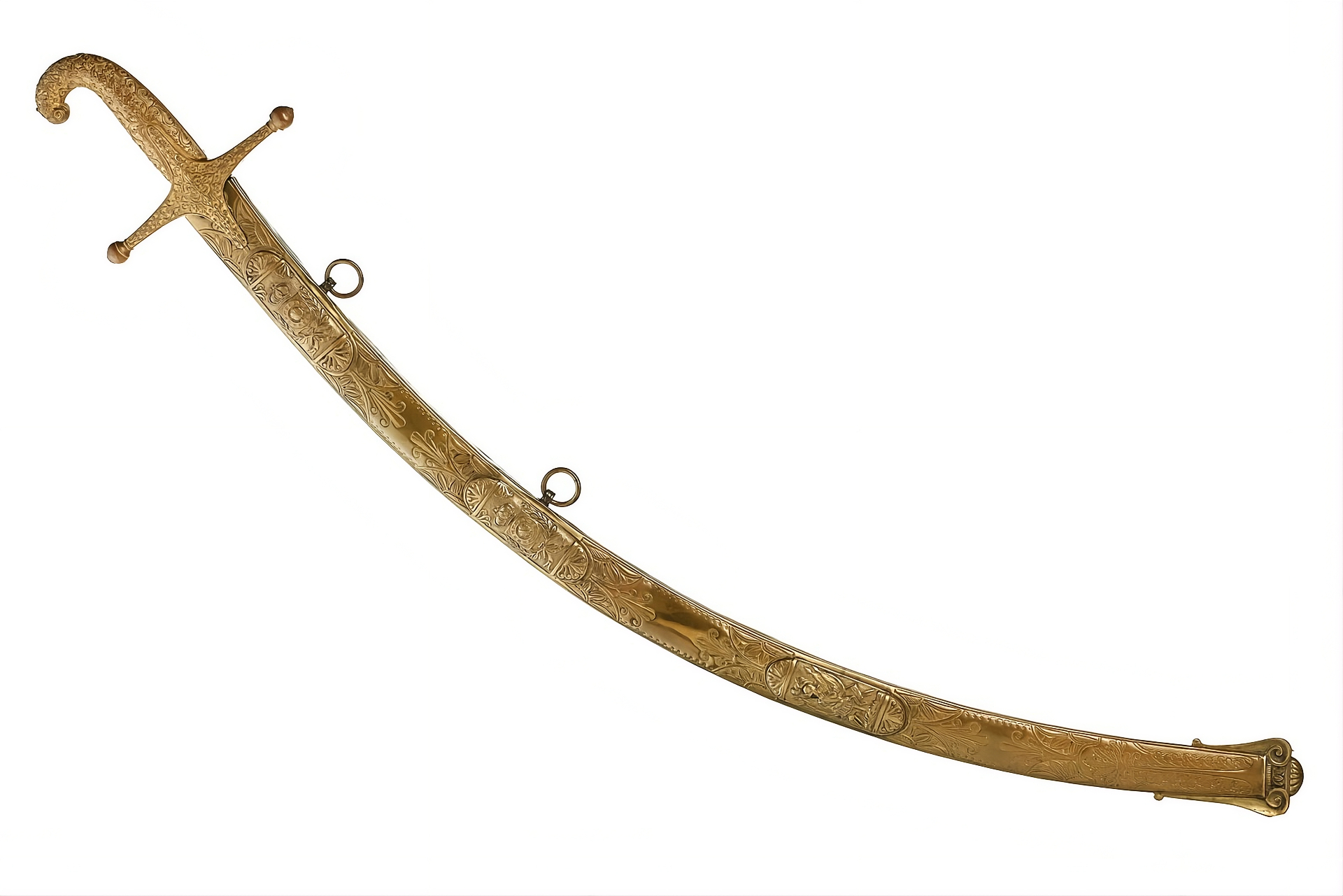
Saber of a Superior Officer from the reign of Emperor Dom Pedro II
Guard in yellow metal, in the so-called Mamluk style, profusely chiseled with vegetal motifs. Curved blade richly engraved with plant motifs and trophies of arms. Yellow metal scabbard engraved with stylized vegetal decoration, with three applied reserves: the upper two bearing the National Arms of the Empire of Brazil and fitted with two suspension rings, and the lower reserve decorated with trophies of arms. Empire-style knuckle guard.
- Date
- c. 1850-1880
- Origin
- Brazil
- Period
- Imperial Period (1822–1889)
- Materials
- Yellow metal scabbard engraved with plant motifs. Steel blade.
- Dimensions
- Overall length approx. 88.5 cm; blade length approx. 78 cm
- Condition
- Good, signs of rust
Provenance
Acquired from Portuguese auction house in 2022.
Historical Context
This saber dates from the Second Reign of Brazil (1840–1889), under Dom Pedro II, a period marked by political stability, territorial consolidation, and the professionalization of the imperial armed forces. Military officers occupied a prestigious position within the imperial order, serving not only as instruments of defense but also as symbols of state authority and constitutional continuity.
The Mamluk-style guard reflects a broader nineteenth-century European and imperial fashion that drew inspiration from Near Eastern and Napoleonic-era military aesthetics. Such exoticized forms were widely adopted by elite cavalry and officer corps as markers of distinction, elegance, and martial tradition. In Brazil, these stylistic choices linked imperial officers visually to the broader Atlantic world of monarchical and professional armies.
The richly engraved blade and scabbard, adorned with vegetal motifs and trophies of arms, emphasize the ceremonial and representational function of the saber. While fully capable of use, weapons of this type were primarily intended for parade, formal duty, and social display, reinforcing hierarchy, honor, and rank within the officer corps. The presence of the National Arms of the Empire of Brazil explicitly tied the bearer's authority to the person of the Emperor and the legitimacy of the imperial state.
As an object, this saber embodies the self-image of the Brazilian Empire: orderly, cultivated, and sovereign. It reflects a military culture that valued discipline, symbolism, and continuity over revolutionary rupture. In the context of Dom Pedro II's reign, such arms were not merely weapons but instruments of statecraft, projecting imperial dignity at home and Brazil's status as a stable constitutional monarchy abroad.
Why This Item Matters
- Represents the authority and stability of the Brazilian Empire under Dom Pedro II
- Reflects the professionalization and prestige of the imperial officer corps
- Illustrates global military aesthetics adopted by nineteenth-century monarchies
- Serves as a ceremonial symbol of sovereignty rather than a battlefield weapon
Cite This Page
"Saber of a Superior Officer from the reign of Emperor Dom Pedro II," Brazilian Heritage Collection, accessed September 19, 2026, https://www.brazilianheritagecollection.com/collection/saber-superior-officer-pedro-ii.
Disclaimer: The information presented here represents our best-faith scholarly understanding based on available evidence. The Brazilian Heritage Collection does not offer legal guarantees of authenticity. Serious inquiries regarding provenance documentation are welcome from qualified researchers and institutions.