Lições da Historia do Brasil
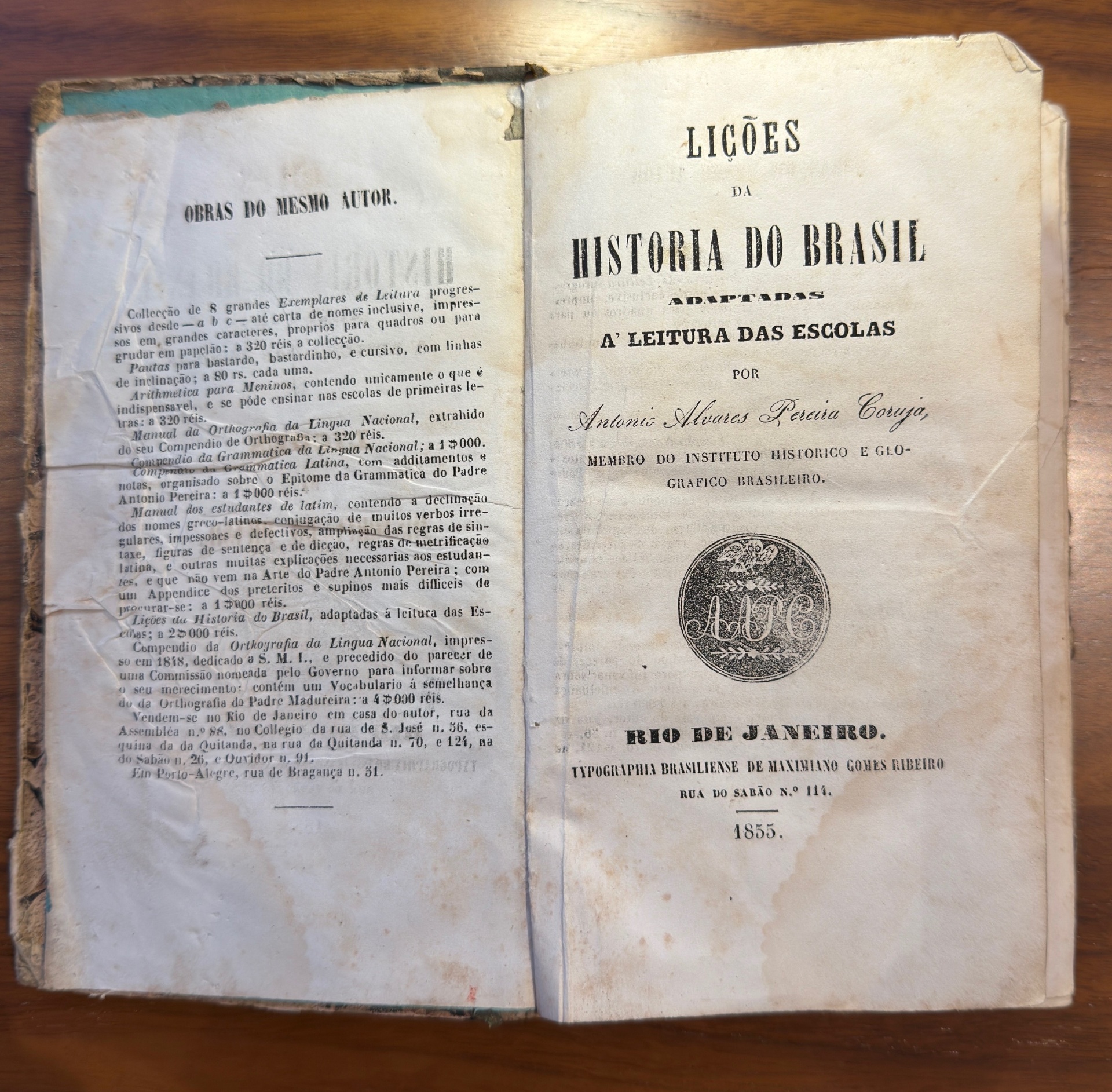
Antônio Álvares Pereira Coruja's foundational school text on the history of Brazil, structured in concise lessons to introduce young readers to the discovery, colonization, captaincy system, missionary activity, and institutional formation of the Empire of Brazil.
- Date
- 1855 (1st edition)
- Origin
- Rio de Janeiro, Brazil
- Period
- Imperial Period (1822–1889)
- Materials
- Paper, half-calf binding with marbled boards
- Dimensions
- 22 x 15 x 3 cm
- Condition
- Good, signs of aging, some stains.
Provenance
Acquired from a Portuguese dealer in Lisbon specializing in rare books.
Historical Context
The first edition of Lições da Historia do Brasil marks an important moment in the intellectual consolidation of Imperial Brazil. Written by Antonio Álvares Pereira Coruja, a member of the Instituto Histórico e Geográfico Brasileiro (IHGB), the work was conceived explicitly as a school textbook, designed to introduce Brazilian history to primary students in a structured, accessible format.
Appearing only a few decades after Independence (1822), the book belongs to a formative phase of Brazilian national identity. During this period, the Empire sought to create a unified historical narrative capable of integrating vast and culturally diverse provinces into a coherent political nation under the Crown.
Coruja organized Brazilian history into clear "Reinados" (reigns) and concise "Lições" (lessons), making the national past readable and pedagogically systematic. The narrative begins with Indigenous societies, proceeds through the Portuguese discovery, the Captaincy system, the establishment of the General Government, missionary activity, territorial defense, and colonial expansion. The structure reflects the historiographical orientation promoted by the IHGB: institutional, monarchic, and civilizational in emphasis.
Unlike later revised editions, the first edition preserves the author's original framing, before subsequent augmentations and corrections. As such, it offers a direct window into mid-19th-century Brazilian historical thought and educational priorities.
The Author
Antônio Álvares Pereira Coruja (1806–1889), born in Porto Alegre to a family of modest means, rose through education and intellectual discipline to become one of the notable pedagogical figures of Imperial Brazil. Originally baptized Antônio Álvares Pereira, he acquired the nickname "Coruja" ("Owl") during his student years, later incorporating it into his name. Trained in Latin and classical studies, he began teaching at a young age and quickly gained recognition as a public instructor of grammar, philosophy, and primary education.
After moving to Rio de Janeiro in 1837, he established schools, published influential grammar manuals, and became deeply involved in educational reform. His Compendio da grammatica da lingua nacional enjoyed multiple editions and wide circulation. A long-standing member and treasurer of the Instituto Histórico e Geográfico Brasileiro, he contributed to the intellectual life of the Court and helped shape historical discourse in the Empire. Decorated as an Officer of the Imperial Order of the Rose and Knight of the Imperial Order of Christ, Coruja combined the roles of educator, historian, journalist, and public intellectual. Despite later financial hardship, his legacy endures, particularly through his historical and educational works.
Why This Item Matters
- Early Imperial schoolbook shaping Brazilian historical consciousness
- Authored by a prominent educator and member of the IHGB
- Preserves the original mid-19th-century narrative before later revisions
- Tangible artifact of Brazil's educational and nation-building project
Cite This Page
"Lições da Historia do Brasil," Brazilian Heritage Collection, accessed September 27, 2026, https://www.brazilianheritagecollection.com/collection/licoes-historia-brasil-coruja.
Disclaimer: The information presented here represents our best-faith scholarly understanding based on available evidence. The Brazilian Heritage Collection does not offer legal guarantees of authenticity. Serious inquiries regarding provenance documentation are welcome from qualified researchers and institutions.