The Empire of Brazil at the Universal Exhibition of 1876 in Philadelphia
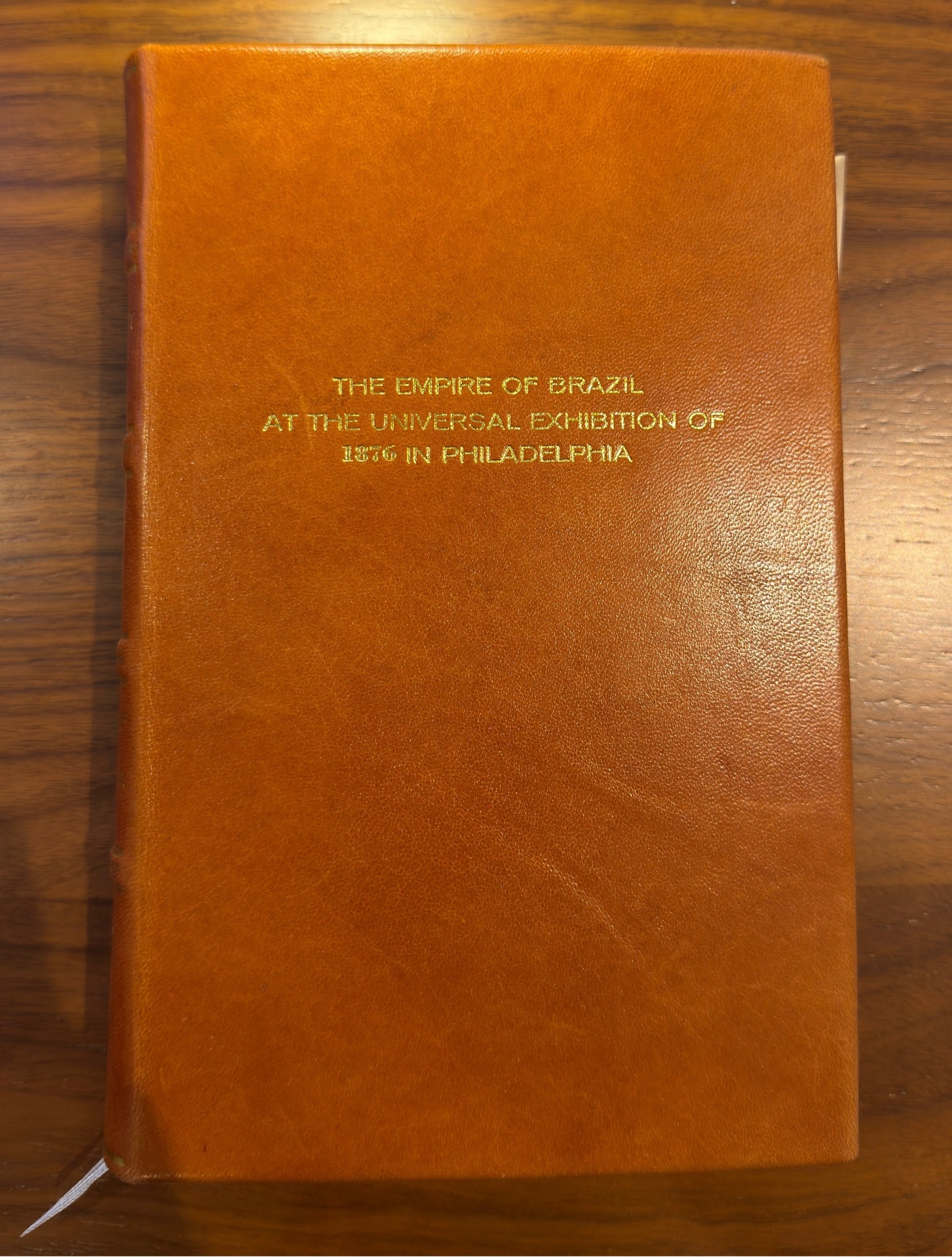
A comprehensive late-nineteenth-century English statistical compendium presenting the Empire of Brazil as a modern, orderly, and economically advancing constitutional monarchy through detailed data on its infrastructure, institutions, industry, and national development.
- Date
- 1876 First Edition
- Origin
- Rio de Janeiro, Brazil
- Period
- Imperial Period (1822–1889)
- Materials
- Paper, bound in full brown calf with gilt trim and silk marker
- Dimensions
- 56 x 38 cm (folio)
- Condition
- Near fine.
Provenance
American Bookseller.
Historical Context
This first edition volume, bound in full brown calf with gilt trim and silk marker, belongs to the mature phase of the Empire of Brazil, a period marked by institutional consolidation, territorial administration, and economic modernization. Produced in English and clearly intended for an international readership, the book reflects Brazil's effort to present itself as a stable, orderly, and progressive nation within the global community of the late nineteenth century.
The detailed statistical surveys, covering railroads, electric telegraphs, docks, finance, public debt, banking establishments, and limited liability companies, illustrate a country integrating modern capital infrastructure into a vast continental territory. The fold-out maps and charts, preserved here in pristine condition, were not decorative additions; they were instruments of persuasion. They visually documented Brazil's expansion of transport and communications networks, symbols of sovereignty and commercial viability in an age when industrial capacity defined national prestige.
At the same time, the book offers a comprehensive portrait of imperial administration. Chapters addressing the Constitution, division of the Empire, public force, arsenals, military colonies, and the Navy underscore the strength of centralized governance under constitutional monarchy. Other sections, on libraries, museums, scientific societies, theatres, and the press, demonstrate the regime's emphasis on intellectual and civic life, reinforcing the Preface's claim that Brazil was a "peaceful, intelligent, and laborious people."
The inclusion of topics such as catechization of Indigenous populations, naturalization of foreigners, and charitable establishments reflects the imperial state's social policies and its approach to internal integration. Likewise, the extensive treatment of agriculture, mineral resources, and industry highlights Brazil's identity as both a fertile agrarian power and an emerging industrial participant in global markets.
The Preface's reference to Universal Exhibitions is particularly telling. Quoting the Preface, "If, as yet, Brazil has not appeared as a competitor at Universal Exhibitions, it will be admitted, that they have afforded to the country opportunities of becoming known, and estimated as an agricultural region, possessing an extremely fertile soil, and to its inhabitants the occasion of appearing as a peaceful, intelligent, and laborious people." Though Brazil had not yet stood as a major industrial competitor, the nation sought recognition as a serious and orderly agricultural empire with expanding capital industries. In this respect, the book functions as a national statement, part statistical compendium, part diplomatic instrument.
Typographically, the varied styles on the title page exemplify late nineteenth-century printing aesthetics, conveying both authority and modernity. As an artifact, this volume is more than a reference work: it is a carefully constructed presentation of Brazil at a moment when it stood among the most stable and territorially expansive states in the Americas.
Within a virtual gallery context, the book represents the Empire's self-conscious projection of progress, measured, documented, and mapped, at the height of its institutional confidence on the eve of the political transformations that would close the imperial era in 1889.
Why This Item Matters
- Captures the Empire of Brazil at the height of its modernization and institutional order
- Documents railroads, telegraphs, finance, and industry through official statistics
- Intended to shape foreign perception and attract international engagement
- Preserves pristine fold-out maps and charts evidencing national progress
Cite This Page
"The Empire of Brazil at the Universal Exhibition of 1876 in Philadelphia," Brazilian Heritage Collection, accessed September 26, 2026, https://www.brazilianheritagecollection.com/collection/empire-brazil-philadelphia-1876.
Disclaimer: The information presented here represents our best-faith scholarly understanding based on available evidence. The Brazilian Heritage Collection does not offer legal guarantees of authenticity. Serious inquiries regarding provenance documentation are welcome from qualified researchers and institutions.