Bill of Sale for an Enslaved Person (Brazil, 1858)
Extremely rare Bill of Sale for an Enslaved Person.
- Date
- 1858
- Origin
- Rio de Janeiro, Brazil
- Period
- Imperial Period (1822–1889)
- Materials
- Paper, ink
- Dimensions
- 31 x 21 cm (folded letter)
- Condition
- Delicate, signs of ink staining.
Provenance
Acquired through auction 2025
Historical Context
This is an extremely rare Bill of Sale for an Enslaved Person (or similar title), dated to the period of the Empire of Brazil. It is a piece of inestimable historical, social, and museological value, essential for the study of slavery in Brazilian history.
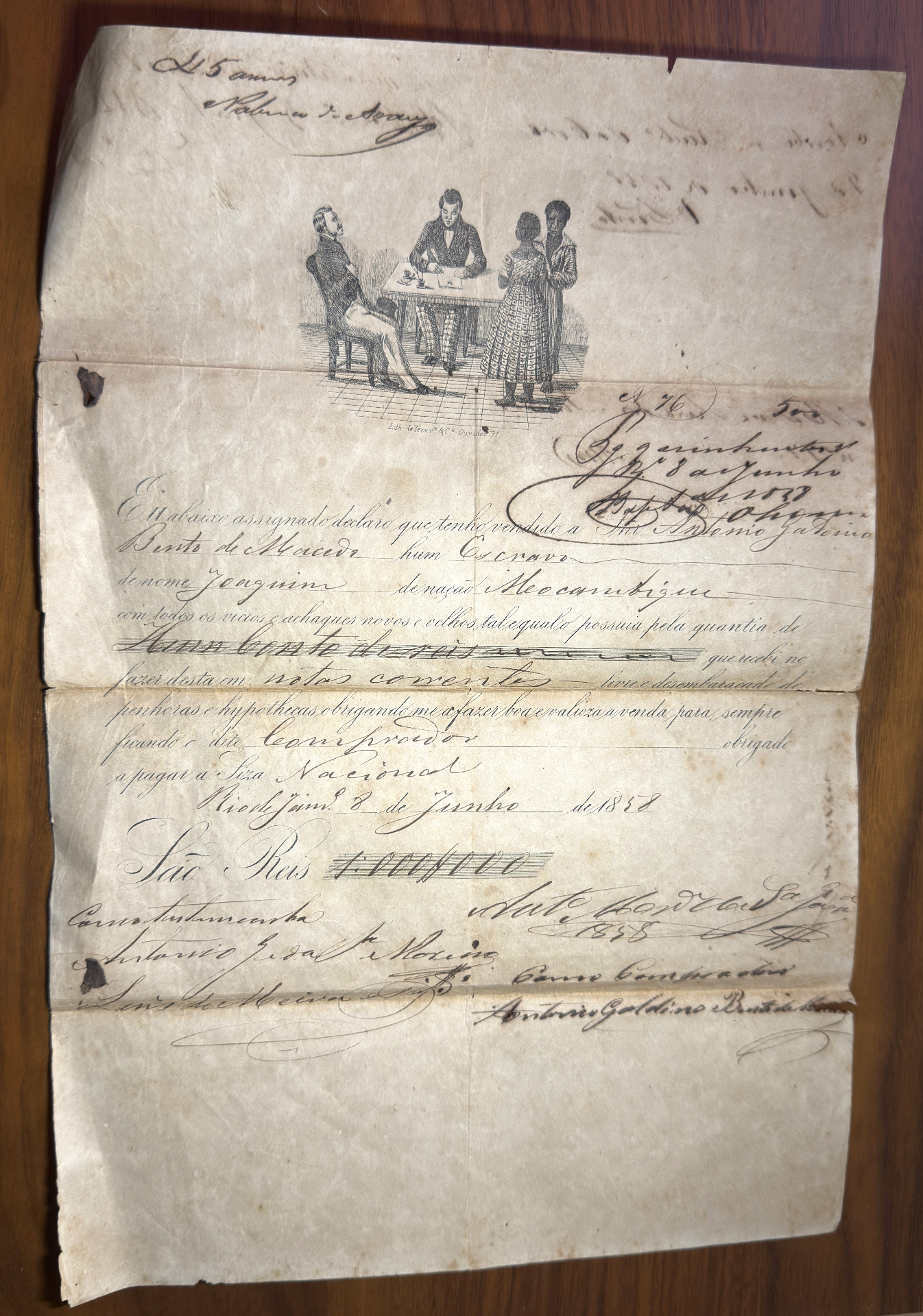
The document is written on thin, aged, yellowed paper, bearing the original fold marks from being folded into four parts; nevertheless, it remains firm, intact, and fully legible. It was issued in Rio de Janeiro on June 8, 1858—only three decades before the enactment of the Lei Áurea (Golden Law), which abolished slavery in Brazil.
The document records the purchase of an enslaved man for the amount of "One Conto de Réis" (1:000$000). It identifies the individual as a "crioulo" named Joaquim, likely of "Nação Moçambique" origin (to be confirmed). It includes the legal clause of "Vício Redibitório" (redhibitory defect), a common contractual provision at the time, certifying that the person sold was free from any "illness" or defects that might diminish the value of the "property."
At the top, there is a printed lithographic vignette depicting an office scene: two white men seated at a desk (the clerk and/or purchaser) and two Black women standing, possibly symbolizing the transaction or the formal issuance of the document.
The document is signed and contains various legal terms in elaborate handwritten script, as well as indications of fiscal seals or tax stamps attesting to the legality of the transaction at the time.
As a primary source, it offers a direct window into the economic and social system of Imperial Brazil.
Why This Item Matters
- Rare surviving commercial instrument from the final decades of Imperial Brazil
- Documents the legal and monetary structure of slave transactions in 1858 Rio de Janeiro
- Preserves formal contractual language, including the redhibitory defect clause used in property law
- Primary-source evidence of the administrative, fiscal, and notarial practices of the Brazilian Empire
Cite This Page
"Bill of Sale for an Enslaved Person (Brazil, 1858)," Brazilian Heritage Collection, accessed September 26, 2026, https://www.brazilianheritagecollection.com/collection/bill-of-sale-enslaved-person-1858.
Disclaimer: The information presented here represents our best-faith scholarly understanding based on available evidence. The Brazilian Heritage Collection does not offer legal guarantees of authenticity. Serious inquiries regarding provenance documentation are welcome from qualified researchers and institutions.